-cutout_edited.png)
An Extended Timeline of the Life of Saint Pope Kyrillos VI
Updated: Aug 31

August 2, 1902 — Azer Youssef Atta is born in Damanhur, in the governorate of Beheira, to Youssef and Esther Atta — the third of six children and a member of a pious, ecclesial family — and baptized shortly thereafter at Saint Mary’s Church in Mahmoudeya, Beheira.
1907 — Azer accompanies his family in relocating to Tukh al-Nasara, Governorate of Menoufia, where they would reside until 1910. Here, he would complete his primary schooling and, notably, memorize the Gospel of John in its entirety. During these years, Azer and his family made a pilgrimage in November of each year to Ibyar for the festival of Saint Mina, where Azer would often be found foregoing the festivities taking place outside the church in order to attend the liturgical services — the beginnings of his intimate, personal, and lifelong relationship with Saint Mina, and already a clear indicator of not only his lifelong personal love for the altar, but also, more importantly, his sound spirituality, ecclesiology, and liturgical theology.
1910 — Azer and his family relocate once more, to Alexandria, where he would live until leaving the world for the monastery. This year, the Virgin Mary appears in Azer’s family home on Nile Street, “with her luminous garments and glittering crown,” healing a member of his family and leaving a lasting impression on his life such that he noted in 1968, in an interview with Akhbar Al-Youm newspaper, that the image of this visitation had always remained since the encounter “a source of radiant blessing in my family’s home. She instilled faith in our souls, and we all grew up with this love for her. This holy, blessed event has never left my mind.”

[The front page of the May 11, 1968 Akhbar al-Youm newspaper, featuring an interview with Pope Kyrillos regarding the Zeitun Apparitions]
1920 — Azer completes his schooling and earns his baccalaureate. Shortly thereafter, he begins employment as an account manager with Thomas Cook & Son, a British company. Before beginning his shift every day, Azer would attend the morning prayers at Saint Mark’s Cathedral in Mahatet al-Ramleh, Alexandria. After work, he would visit his mentor, Archdeacon Iskander Hanna — who would ultimately prove instrumental in convincing Azer’s family to agree to his pursuit of the monastic life — for guidance. In the evenings, he would spend his time alone in his room, praying and reading the Scriptures, as he longed for the monastic life.

[Azer Youssef Atta]
June 1927 — Azer resigns from his position at Thomas Cook & Son. Upon being confronted by his older brother regarding this decision, he replied: “Which is preferable? A holy life and real internal happiness, or the suffering and painful life one must live in the secular world?”
July 27, 1927 — Azer departs Alexandria to join the Baramos (Ⲡⲁⲣⲱⲙⲉⲟⲥ) Monastery, where he quickly becomes the disciple of Fr. Abdelmassih al-Masudi, a renowned scholar and saintly ascetic. During his novitiate, Azer undertook the most difficult and unpleasant tasks of the monastery with obedient gratitude, concern, and complete faithfulness — serving the elder monks, cleaning their cells, washing their clothes, and even carrying out the duties of the monastery kitchen. Amidst and despite these tasks, Azer diligently continued his prayers, study of the Scriptures, and daily liturgical practice.
February 9, 1928 — At the request of his mentor, Fr. Abdelmassih, Azer publishes the first of what would ultimately total 23 volumes of a monthly theological periodical titled Harbor of Salvation, in which he presented various excerpts from Patristic and desert literature while contributing personal theological discourses and narratives containing either autobiographical notes or quotations from contemporary Christian writings. Every one of the fifty copies prepared of each volume was meticulously handwritten by Azer.
February 24–25, 1928 — Azer is tonsured as a monk at the Baramos Monastery by the name Fr. Mina al-Baramosy, at the unanimous nomination of the monks and with the abbot’s approval.
July 18, 1931 — Fr. Mina al-Baramosy is ordained to the presbyterate by Bishop Demetrius of Menoufia. At his ordination, as at his monastic tonsuring, he wept bitterly and openly, bringing all who were in attendance to tears. Upon being ordained, Pope Youannis XIX personally requested that Fr. Mina complete his forty days’ preparation at the Cathedral of Saint Mark in Alexandria, and to receive the oblation there. It appears that Fr. Mina underwent this period of preparation and instruction at the hands of Pope Youannis himself.
1931–1933 — Following Fr. Mina’s ordination, Pope Youannis requested that he undertake theological studies at the newly established Clerical College in Helwan — a request that arose from Pope Youannis’ convictions as to the importance of formal theological education for monks. Fr. Mina acquiesced out of obedience to the patriarch. During the period of his studies, in which he is noted to have been quite successful, Fr. Mina and his new friend, Fr. Kyrillos of the Monastery of Saint Paul the Anchorite, prayed every day the prayers of the raising of incense, the praises, and the Divine Liturgy, and even succeeded in having this schedule adopted as the official daily schedule of their theological school. At one evening raising of incense presided over by Fr. Mina at the School, Pope Youannis unexpectedly arrived and attended as Fr. Mina delivered the homily, which lasted a full hour. In light of the richness and power of that homily, Pope Youannis blessed Fr. Mina, praying that he would be “a pillar of the Church of God,” and expressed to the Dean of the School that he intended to ordain Fr. Mina to the episcopacy. Upon learning of this intention, in early 1933, Fr. Mina abruptly, immediately, and secretly left the School in the middle of the night, fleeing by train to the White Monastery of Saint Shenouda over 260 miles away. Shortly thereafter, by August 1933, he had returned to the Baramos Monastery, choosing the second of two choices presented to him by Pope Youannis after formally declining the episcopacy.
December 1933/January 1934 — After several months of negotiation and debate between Fr. Mina and the monks of the Baramos Monastery, Fr. Mina finally obtains permission to commence the solitary life he had long desired, and departs the monastery for a cave he had previously discovered during the journey of his return to the monastery in mid-1933, which had been carved out by one Hegumen Sarabamon. Before departing, Fr. Mina promised his mentor, Fr. Abdelmassih al-Masudi, to return to the monastery each week for the liturgical prayers commencing on Saturday evening and concluding with the Sunday Liturgy. His first night in the cave was, in his own words, incredibly fearful, characterized by “terrible sounds and forceful earthquakes” brought about by the demons. Yet Fr. Mina describes that he felt God’s “invisible power” that night, so that the fear departed from him. At this cave, Fr. Mina continued in daily prayers, prostrations, and scriptural and patristic reading, and was once especially visited there by Pope Youannis, despite his being eighty years old, out of his desire to receive a “blessing from the cave that had become holy through the spiritual struggle of” Fr. Mina.
April 4, 1936 — Fr. Mina the Solitary departs the Baramos Monastery on Lazarus Saturday to accompany and serve seven elderly monks in their expulsion from the Monastery, and takes up residence with them first at the Monastery of Archangel Michael in Old Cairo, and then in a two-story rented house nearby. Soon thereafter, Fr. Mina personally intercedes for them with Pope Youannis, who has mercy on them and permits their return to their Monastery. While Fr. Mina did not hesitate to take upon himself the responsibility of serving and defending the seven monks, this came at the cost of his beloved cave — a sacrifice that caused him much grief.
June 1936 — As the seven monks return to their Monastery, Fr. Mina obtains permission from the pope to reside in a remote, abandoned windmill in the Eastern Mountain, on the outskirts of Old Cairo, discerning that he would “receive God’s comforting grace” there. He subsequently obtains special permission to reside there from the Director of the Arabic Antiquities Organization, as the place was a protected site, and signs a lease for the place on June 23, 1936, providing for a monthly rent of only half a piaster. While living at the windmill, Fr. Mina returned to the Monastery of Archangel Michael each Sunday to attend the Divine Liturgy, quietly leaving immediately after the conclusion of the service. Otherwise, his days began at 2 AM with the midnight watches of the Agpeya, followed by the midnight praises, baking the offertory bread, offering the morning raising of incense, and celebrating the Divine Liturgy along with those who would come to attend the prayers with him, whose numbers only increased in proportion to his spreading renown as a blessed, prayerful, and wonder-working monk.


October 28, 1941 — Fr. Mina is evicted from the windmill by the governing authorities due to a purported archaeological excavation that, conveniently, was claimed to be required precisely beneath the windmill — which, it should be said, never actually occurred. From this day until late 1943, Fr. Mina was without a permanent residence, moving from place to place, including staying at the Monastery of Archangel Michael in Old Cairo and the Church of Saint Mary at Babylon in Old Cairo, and even having no choice, on at least one occasion, but to sleep on the pavement in front of a locked church.
Late 1943 — Fr. Mina is appointed abbot of the Monastery of Saint Samuel by Metropolitan Athanasius of Beni Suef, and arrives there in late December of the same year to find it in severe disrepair. Yet Fr. Mina expressed that he perceived it as being, spiritually, indescribably beautiful and overflowing with blessings and grace. Fr. Mina immediately began the work of effectuating the necessary repairs and even expansions at the monastery and its off-campus center, until he had restored it and rendered it once again inhabitable. He then left there his disciple, Fr. Mina the Younger, to oversee the daily affairs of the monks (and eventually become its abbot in 1954), while he returned in early 1945 to reside in his windmill once again. From there, he cared for the monastery from afar, sending several letters to its monks and visiting them from time to time.
Mid-1945 to Mid-1946 — After only residing at the windmill for a few months, Fr. Mina is evicted once again. He therefore again resorts to moving between the Monastery of Archangel Michael and the Church of Saint Mary at Babylon, and even, at one point, spends forty days with his family in Alexandria for lack of living accommodations. Amidst these relocations, he is appointed, against his will, the father confessor of the Saint Mercurius Convent in Old Cairo. Finally, in mid-1946, following a papal decree requiring all monks to return to their respective monasteries, Fr. Mina requests and is granted by Pope Yousab II official permission to pray at the Monastery of Archangel Michael in Old Cairo.
1947–1959 — In early 1947, while Fr. Mina was residing in a small room at the Monastery of Archangel Michael, he learns — possibly, according to his own vague words, from his dear friend, Saint Mina — that a neighboring property was for sale. Shortly thereafter, he succeeds in purchasing the property, and that at a 33% discount provided by its prior owner upon learning that it would be for Saint Mina. According to Fr. Mina, an old lady was present for the discussion and paid the required sum “on the spot.” And so commenced the construction of the Monastery of Saint Mina in Old Cairo, which was consecrated at the end of the same year by none other than Metropolitan Athanasius of Beni Suef, along with Metropolitan Abraam of Giza. It was in this place that Fr. Mina continued to carry out his customary schedule of daily prayers, beginning at midnight, while attending to the needs of the many students who, being attracted by his piety, simplicity, wisdom, and prayerfulness, began to gather around him and become his disciples. It is said that he only ventured beyond the gates of the Monastery once in over a decade, only to undergo a necessary appendectomy. Among the activities he either carried out or oversaw at the Monastery during this period were daily hymn and Coptic language classes for children, the assembling of a reference library, lectures for young adults, and even vocational training programs. He even built a boarding house on the property to host students coming to attend Cairo University from out-of-town, who were only accepted to reside there if they had a letter of recommendation from their parish priest and agreed to adhere to the monastery’s rules and attend the Divine Liturgy regularly. And so countless disciples, especially from among the well educated and spiritually sincere members of the Sunday School Movement, were attracted to Fr. Mina and became regular attendees and students at Saint Mina’s Monastery, finding in Fr. Mina acceptance and encouragement, much-needed guidance, a pious example, and heartfelt fatherhood — all of which they unfortunately often lacked in their home parishes — all while witnessing his life of unceasing prayer and the many signs God regularly performed at his hands there. These disciples included, most notably, Zareef Abdullah (a founder of the Sunday School Movement in Giza, and later ordained Fr. Boulos Boulos, the first member of the Sunday School Movement to be ordained to the priesthood), Waheeb Zaky (later Fr. Salib Suriel, a well-respected teacher of the Coptic Church in the twentieth century who had been a disciple of Fr. Mina since 1936, while he was still living at the windmill), Saad Aziz, who would be tonsured a monk by Fr. Mina himself on April 14, 1948 by the name of Makary at Saint Mina’s Monastery and eventually become Anba Samuel of Ecumenical and Social Services, Waheeb Atallah, who had initially become a disciple of Fr. Mina at the windmill and would ultimately become Bishop Gregorios of Higher Theological Studies, Coptic Culture, and Scientific Research, Abdelmessih Bishara, who would succeed Metropolitan Athanasius of Beni Suef as Bishop Athanasius of Beni Suef, Soliman Rizk, who would become Bishop Mina Ava Mina and ultimately be appointed abbot of the Monastery of Saint Mina that would one day be built by Fr. Mina after his enthronement as Pope Kyrillos VI, Mikhail Ibrahim, who would ultimately be ordained Fr. Mikhail Ibrahim, and countless other future clergymen and faithful servants of the Church. Perhaps foremost among the disciples of Fr. Mina at the Monastery of Saint Mina was a young member of the Sunday School Movement in Saint Anthony’s Church in Shubra, Nazir Gayed, who would eventually become Fr. Antonios al-Suryani, then Bishop Shenouda of Christian Education, and finally succeed his mentor in the papacy as none other than Pope Shenouda III. During these years, while within the gates of the Monastery of Saint Mina was a paradise of piety and prayer and a safe haven for many, outside grew, among certain ecclesial hierarchs and influential figures, especially within the patriarchate, animosity and disdain for Fr. Mina, leading to various attempts at thwarting his efforts, suppressing his growing influence, and even an attempt, foiled at the last minute, to kidnap him so as to forcibly remove him from the Monastery and isolate him from his many disciples. Despite these tribulations, Fr. Mina persisted unfazed in his life of solitude and ceaseless prayer, being supported firstly by God’s grace and secondly by the love of his disciples and the defensive interventions of his supporters from among the episcopacy, most especially Metropolitan Athanasius of Beni Suef.

April 19, 1959 — Having been nominated to the papacy against his will and without his knowledge by Metropolitan Athanasius of Beni Suef, and having received the third-highest number of votes in the final election, Fr. Mina is selected by altar ballot as the 116th pope of Alexandria and patriarch of the See of Saint Mark. He learns of the announcement as he prays the Divine Liturgy at Saint Mina’s Monastery in Old Cairo and begins to weep, being heard praying, by those around him after the service: “I have always lived as a solitary, my God, and I would have continued to live and die solitary. But you have not wanted it. My God, may your will be done, for your will is impenetrable and you are mysterious, O Lord.”


May 9, 1959 — Fr. Mina travels to the Baramos Monastery— his first time returning since he left it on April 4, 1936 — and thereafter visits the remaining monasteries of Wadi al-Natrun. At the Syrian Monastery, his disciple, Nazir Gayed, who had five years prior become a monk there under the name Fr. Antonios al-Suryani, is asked to deliver an address in his presence, during which Fr. Mina weeps openly. That evening, Fr. Mina returns to Cairo, where he is welcomed by thousands of believers, and arrives at the cathedral, where he prays the evening raising of incense, according to his custom, before retiring to his room.
May 10, 1959 — At 2:30 AM, Fr. Mina requests that the guard of the papal residence open the doors of the church, where he prays, as a matter of course, the midnight and morning praises and morning raising of incense, before attending the early liturgy as a mere attendee, as he would pray the later Liturgy during his ordination to the papacy that very day. And so, only a few hours later, Fr. Mina is ordained Pope Kyrillos VI, weeping throughout the entirety of the ordination service and even asking Bishop Lucas of Manfalout to deliver his personal address to the congregation in his stead. Therein, Pope Kyrillos VI movingly expresses his sense of awe before the great responsibility with which he has been entrusted, his trust in God’s grace and support, his deep love for the flock, and his hope that the clergy and laity would work cooperatively with him for the edification of the Church of God. Among his concluding remarks, he says: “may we disappear that He may appear with His blessed glory. I ask the Lord that He may grant us all oneness of spirit and heart and thought, that we may work together with one mind and one will, that is the will of the Holy Spirit, Who has guided the Church throughout her long glorious history. And we have one holy goal: the glory of God and the service of Truth and the highest aspirations.” After the liturgy, Pope Kyrillos stands and refuses to sit, despite the heat of the day and the lengthy prayers that had just concluded, while he greets, one person at a time, the thousands in attendance at the blessed event — in stark contrast to the closed-door policies of his predecessor, who had installed iron bars on the windows of the patriarchate and erected a barricade there. Pope Kyrillos would henceforth become perhaps the most accessible patriarch in the Church’s storied history. Each day, following his usual morning prayers, which began at approximately three in the morning and concluded at around eight in the morning, he would meet with countless visitors amidst his other obligations — whether official meetings or other papal duties — until six in the evening, when he would “go to his work” of praying the evening praises and the evening raising of incense, after which he would continue to receive guests until about midnight. These visitors came to him for a multitude of reasons — personal and professional problems, guidance, complaints, demon possession, illnesses of various sorts, or merely to receive his blessing — and invariably found in him a patient smile, a listening ear, penetrating insight, timely austerity, clarity of mind, gifts of healing, prophecy, and exorcism, a warm sense of humor, and a gracious and fatherly heart that was all-encompassing. Meanwhile, the pope maintained his ascetical disposition and preference for silence — his food was almost entirely comprised of simple bread, spices, and cooked vegetables, and his clothing consisted of a coarse inner garment, a leather belt, the monastic Eskim, a lighter outer garment, an outer cassock, a shawl, and a tattered pair of shoes which he never exchanged or repaired. His sleep was short and interrupted, on a thin brass bed with a light covering regardless of the season, on which he slept in a rigid position on his side, with legs unbent. In all, a man of prayer, silence, and unfathomable simplicity, whose exalted rank paradoxically engendered within him an even deeper prayerfulness, humility, simplicity, patience, and life of asceticism, much to the dismay of many among the clergy and laity, who carried out a brutal campaign of hostility, slander, and defamation against him, especially during the early years of his papacy.


June 7, 1959 — Pope Kyrillos consecrates the first bishop of his papacy, Metropolitan Basil IV of Jerusalem, a former student of Saint Archdeacon Habib Girgis who had gone on to earn a doctorate degree from the School of Theology at the Aristotle University of Thessaloniki. The See of Jerusalem had been vacant for three years, since the repose of its previous Metropolitan, James II of Jerusalem, in 1956, and so His Holiness made it a matter of urgent priority to consecrate a metropolitan for it immediately following his own consecration. Upon hearing of the pope’s intention to ordain him, Metropolitan Basil IV, then Hegumen Cyril al-Antoni, escaped and went into hiding, only to then relent and accept the ordination at the pleas of his personal acquaintances and upon discerning the will of God.
June 22, 1959 — Pope Kyrillos VI journeys into the desert at Mariout, as one of his first official acts as patriarch, to consecrate the site, and initiate the (re)establishment of Saint Mina’s Monastery in the same desert where, until a millennium before, his shrine and monastery had attracted countless pilgrims from all over the Christian world. This had long been a desire and hope of Pope Kyrillos — in 1937, he had requested permission from Pope Youannis XIX to commence this project, only to be told, rather sarcastically, “have we finished rebuilding the cities to begin rebuilding the desert?” Then, in 1943, he had tried once more to obtain permission for the undertaking, only to once again fall short of success; and finally, in 1946, he had asked his brother Hanna to assist in obtaining the necessary clearances, again to no avail. This situation persisted until March 5, 1958, when, after the death of Pope Yousab II, the Maglis finally decided to rebuild Saint Mina’s Monastery. In correspondence written that night, Pope Kyrillos, then still Fr. Mina, elatedly declared: “I was so happy and glad for this news to the extent that I could not go to sleep before writing this letter. . .” In another letter prepared the same night, he wrote: “I plead to the almighty Lord Jesus to declare his will and grant me the desire of my heart, to see with my eyes the renovation of this monastery.” However, the issue of the Monastery would be cast aside amidst the climate of the day and Fr. Mina’s election and enthronement, until this fateful day when he arrived to the site in the desolate wilderness of Mariout to consecrate the place and commence the long-awaited restoration. Soon thereafter, on November 27, 1959, two days after the annual commemoration of the martyrdom of Saint Mina, Pope Kyrillos would return to celebrate a liturgy at the tomb of Saint Mina before driving to a nearby site and laying the foundation stone for what would eventually become the great Monastery of Saint Mina there. Upon his arrival that day, rain fell in that area, ending a longstanding drought. The project was met with woeful disdain at all levels, both inside and outside the Church — one western scholar comments, now, in hindsight, quite comically: “who, one wonders, will visit it? Who needs it?” And many Copts, even among the clergy, repeated the same bewildered phrase: “he is taking the money of the Copts and throwing it in the sand!” But Pope Kyrillos saw in the place what many if not all of his contemporaries failed to discern: a divinely ordained opportunity to revive the veneration of a long-forgotten and yet still entirely alive and active saint, and along with it the life of genuine prayer and sound monasticism practiced in public view, thereby inspiring to the same manner of life, with the aid of the multitude of miracles performed there, all who came to receive the blessing of the place, who had been largely deprived of the life of prayer and the experience of genuinely pious clergymen in the unfortunate decades preceding the papacy of Pope Kyrillos, due to the overwhelmingly weak and confused state of ecclesial life and administration during that period.

June 29, 1959 — Only one week after his consecration of the site of the Monastery of Saint Mina in Mariout, as one of his first acts as patriarch, Pope Kyrillos declares the autocephaly of the Ethiopian Orthodox Church and elevates its head, Abune Basilios, to the rank of Patriarch-Catholicos. In this step, Pope Kyrillos heals a decades-long dispute between the Coptic and Ethiopian Churches, wherein the Coptic Church had refused to grant independence to the Ethiopian Church. In immediately permitting the Ethiopian Church to receive its independence, Pope Kyrillos overturns over 1500 years of precedent wherein the Coptic patriarch retained the authority to nominate and consecrate the head of the Ethiopian Church. In so doing, he effectively salvages the relationship between the two Churches and inaugurates a new era of equality between them.
October 12, 1959 — Pope Kyrillos secures a meeting with President Gamal Abdel Nasser with the help of an acquaintance after a tense five months wherein the president refused to visit the pope. Upon arriving to the presidential palace, Pope Kyrillos is met with antagonism and discourtesy by the president. Not feeling particularly welcomed, he abruptly concludes the brief meeting with the words: “enough. I leave you to God. I leave you to God.” He immediately leaves for the patriarchate, where he prays the evening raising of incense upon arriving before continuing his evening as usual and returning to his cell at midnight. Only two hours later, his acquaintance, who had initially arranged the aforementioned meeting, frantically knocks on the door of the patriarchate exclaiming that the president was calling for the pope immediately. After some hesitation, given the late hour, the attendant permitted the man to go himself to knock on the pope’s door. As they approached his room, and before they could knock, Pope Kyrillos opened the door already dressed in his patriarchal attire and made his way towards them, saying: “come, let us go quickly!” Upon arriving, this time to the president’s family residence, Pope Kyrillos exits the vehicle and says: “where is she?” It had happened that the president’s daughter had suddenly fallen ill the prior day, and no diagnosis could be found. Thus, the president felt in his heart that this was related to his disdainful conduct towards Pope Kyrillos and the pope’s rebuke. The pope, seemingly made aware by divine revelation of what had occurred, entered the home alone and prayed for the sick girl, and at once she was restored to perfect health. At the sight of his miraculously healed daughter, the president declared: “from this moment, I will call you my father, and in the future, do not go to the presidential palace, but rather when you meet me, you meet me in my own house. And these children are like your children. Pray for us just as you do for your family.” From then on, Nasser’s disposition towards the pope, and the Copts more generally, took a drastic turn. While previously he had been a negative critic of the Copts and largely uninterested in either their concerns or their newly enthroned pope, now, suddenly, he esteemed Pope Kyrillos greatly in the public eye and was favorable towards the Copts, with his children even contributing the monies for the purchase of the land that would ultimately become the Monastery of Saint Mina in Mariout. Even the president’s own family and closest circle were deeply puzzled by the special concern, admiration, and endearment Nasser exhibited towards Pope Kyrillos. This was, however, not surprising to the pope, who, upon being gently pressed on one occasion by Tamav Iriny, the late saintly abbess of the Monastery of Abu Sefein in Old Cairo, about the flattering words spoken to him by the president in a conversation between them that she had overheard, responded: “has God not shown him miracles?”


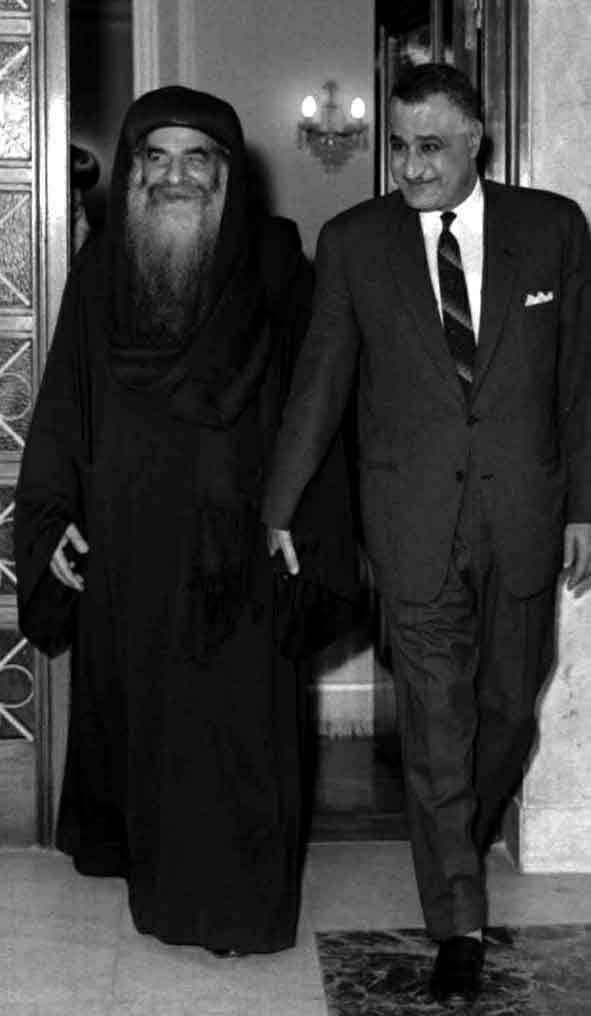
October 26, 1960 — Pope Kyrillos visits Ethiopia for a two-week pastoral tour, the fourth such patriarchal visit in the previous 1500 years. He is hosted for the duration of his stay by Emperor Haile Selassie in his personal imperial residence, where Pope Kyrillos would casually interact with the lions on the property. This would be the first of two visits by Pope Kyrillos to Ethiopia. The trip concluded with a two-day pastoral visit to Eritrea.


June 22, 1961 — At a Synodal meeting at which a certain bishop was to be examined for doctrinal issues, which bishop had also been issuing insulting and derogatory letters against Pope Kyrillos VI, the pope remarks: “do not mention any accusations against [the bishop] that are related to me. I forgive him and am forgoing my rights.” This was entirely in line with His Holiness’ invariable disposition towards those who defamed and derided him: immediate forgiveness and, often, a convicting quip indicative of his awareness of the person’s opposition.
September 9, 1962 — Pope Kyrillos ordains Fr. Macarius al-Suryani, one of his longtime disciples, as Bishop Athanasius of Beni Suef and Bahnasa. Bishop Athanasius would oversee the same diocese that was before him shepherded by Metropolitan Athanasius, who had for many years defended Pope Kyrillos prior to his patriarchate, and who had even nominated him for the papacy. Bishop Athanasius was the first “Sunday School monk” ordained by Pope Kyrillos to the episcopacy, and would go on to serve the Church for almost forty years as a “model and epitome of a diocesan bishop.”

September 23, 1962 — Pope Kyrillos summons Fr. Antonios al-Suryani, formerly Nazir Gayed (who, notably, had been a disciple of the pope since his days at the Monastery of Saint Mina in Old Cairo), urgently from his cave outside the Syrian Monastery. He sends to him Bishop Theophilus, the bishop of the monastery, to call him to the patriarchate. Upon arriving, in his sandy garments, he is met with interrogation by Pope Kyrillos regarding his attire and a recent incident at the Syrian Monastery before the pope asks him regarding the reasons for his purported “refusal” to work with him. Fr. Antonios wittily counters every suggestion by Pope Kyrillos that would have him leave his cave to return to the world in order to work with the pope. As he attempts to leave, Fr. Antonios performs a customary prostration before the patriarch, at which time, in the blink of an eye, Pope Kyrillos takes hold of his head with his unusually large hands and declares: “Shenouda, Bishop of Education!” Bishop Theophilus joins in the moment by likewise placing his hands on Fr. Antonios’ head, before Pope Kyrillos instructs Fr. Antonios that he is not permitted to leave the patriarchate until his ordination takes place the following Sunday, September 30, 1962. Fr. Antonios spends that week at the patriarchate deeply mournful, weeping bitterly and lamenting his impending ordination. In a letter he penned in response to one congratulatory correspondence following his ordination, he writes: “as a matter of fact, a letter of consolation, not of congratulation, was fit for the occasion. How can a monk be congratulated on leaving the calmness of the wilderness and abiding again amidst the disturbance of the city? . . . For me, indeed, it is a matter of shame. I remember that day of my consecration to the episcopacy with tears and lamentation.”
September 30, 1962 — On the morning of the day appointed by Pope Kyrillos for the ordination of Fr. Antonios to the episcopacy, he escorts Fr. Antonios down a staircase of the patriarchate on the way to the church along with a group of those in attendance. Suddenly, he stops, standing still on the staircase for some time in deep prayer as those around them stand by perplexed. Then, just as suddenly, Pope Kyrillos exclaims: “go, get his brother! Quickly! Go, get his brother!” By his brother, Pope Kyrillos was referring to Fr. Makary al-Suryani, who was then serving as the patriarchal secretary. Ever since Pope Kyrillos was Fr. Mina at the Monastery of Saint Mina in Old Cairo, Fr. Makary had been his disciple, beginning as Saad Aziz — his name prior to tonsuring. He had even been ordained by Fr. Mina at that very monastery in 1948, as the first of the “Sunday School monks.” And so, upon being summoned, Fr. Makary comes down the stairs where the pope and Fr. Antonios stood, at which time the pope instructs him to “stand next to [his] brother.” And so that day, His Holiness ordains Fr. Antonios as Bishop Shenouda for the Theological College and Clerical Institutes, and Fr. Makary as Bishop Samuel for Ecumenical, Public, and Social Affairs. With these two brilliant men, Pope Kyrillos inaugurated for the first time in Christian history the position of the “general bishop” to oversee not a physical diocese, but a conceptual one. This reform in the functional structure of the episcopacy, especially in light of the eminent personnel carefully selected by Pope Kyrillos — including not only Bishops Shenouda and Samuel, but also Fr. Pakhom al-Muharraqi, previously Waheeb Atallah, a disciple of Pope Kyrillos since his time at the windmill, who would be ordained on May 10, 1967 as Bishop Gregorios of Higher Studies, Coptic Culture, and Scientific Research — would enable widespread and far-reaching reform, advancement, and ministry in every area of ecclesial significance both throughout Egypt and abroad. It is unsurprising that Pope Kyrillos empowered, sponsored, and chose for episcopal ordination such brilliant servants, all of whom possessing a sincere ecclesial spirit, to serve in these consequential roles — his administrative vision, in harmony with his spiritual disposition, was keen to empower those with the requisite spiritual and intellectual qualifications. As a well-known priest in his day, Fr. Youssef Asaad, summarizes: “[Pope Kyrillos] never worked alone, but always let others participate with him . . . If someone was celebrating the Liturgy in a way that was pleasing to the people, he rejoiced greatly, saying: ‘bring him to pray with me.’ If someone was talented in preaching . . . He would sit and listen to the homily like any other person in the congregation.” Indeed, Pope Kyrillos himself specifically expressed in his first homily, delivered at his ordination, that this would be his method (and, truly, ought to be the method of every genuine servant of God): “may we disappear that He may appear with His blessed glory.”


Late 1962 — Metropolitan Youannis of Giza, who had been ordained in a questionable manner by the prior patriarch, embarks on a campaign to collect signatures in support of a petition to depose Pope Kyrillos, alleging that His Holiness was an uneducated man and overly preoccupied with prayer. Thus he travels throughout Egypt to gather signatures, turning many clergy and laity, as well as several bishops, against the pope. Upon being informed of the plot while praying the evening raising of incense at the cathedral in Alexandria, Pope Kyrillos addresses Saint Mark saying: “this will be the last time I come here to you . . . I will go to the desert and never return if this man’s project succeeds.” The next morning, Metropolitan Youannis is found dead at his residence, having mistakenly consumed, during a coughing fit in the middle of the night, a pesticide from a bottle inadvertently placed next to his medicine bottle on his nightstand. At his funeral, Pope Kyrillos was heard weeping: “all of this, for what? A few pieces of paper with signatures?!” For forty days after that metropolitan’s death, and despite his act of gross disloyalty, Pope Kyrillos commemorated him in every Divine Liturgy. And so it was with each of those who opposed and ridiculed him from among the clergy — with the passing of each of them, Pope Kyrillos would mourn the passing of “his son,” saying: “it is as if a part of my spirit has been taken from me.” Throughout his papacy, Pope Kyrillos kept closest to him those who opposed and challenged him, implicitly finding in them protection for his humility — even the letters found among his personal belongings after his departure were invariably those that insulted and defamed him. He did not keep even one fragment that expressed or contained the slightest hint of positivity or praise towards him, perfectly embodying the words of his teacher, Isaac the Syrian: “honor flees from before the man who runs after it; but he who flees from it, the same will it hunt down, and will become to all men a herald of his humility.”
March 31, 1963 — Following the death of Metropolitan Youannis of Giza, Pope Kyrillos ordains another of his disciples, Fr. Mettias al-Suryani, as Bishop Domadius of Giza. While Metropolitan Youannis had long resisted Pope Kyrillos, and with him the entirety of the Sunday School movement, Bishop Domadius was a faithful disciple to Pope Kyrillos and a supporter of the Sunday School movement. His ordination would therefore prove instrumental in bringing the spirit and vision of the pope into Giza, opening up the diocese to the spiritual reform process taking place throughout the rest of Egypt during His Holiness’ reign.
January 13, 1965 — Pope Kyrillos visits Ethiopia for the second time in order to preside over the Inaugural Oriental Orthodox Conference in Addis Ababa, becoming the first patriarch in history to visit the country twice. Upon disembarking his flight, he is greeted by a military salute and thousands of cheering believers along with Emperor Haile Selassie. Having brought with him the offerings and arrived fasting, his first words to the Emperor are: “I would like to go to the church to pray a Liturgy.” And so he first celebrates the Divine Liturgy before inaugurating the Conference.

May 9, 1965 — Pope Kyrillos travels from Saint Mina’s Monastery in Mariout to Cairo to meet Nasser for the first time in several years. Beginning in early 1964, the Copts had begun once again to face institutional and governmental discrimination, with church building permits revoked, church renovations forcibly halted, and congregations being forcibly removed from their parishes. A church in Helwan Gardens was seized, and another was destroyed by a Muslim mob. While Pope Kyrillos repeatedly wrote to Nasser regarding these concerns, he received no response. And so, in March 1965, the Synod convened and requested of Pope Kyrillos that he go to the president directly. However, given the unpredictability of the situation and the fact that he had not spoken to the president in several years, he instead spent the entirety of Great Lent that year in Alexandria, before proceeding to celebrate the Pascha at his beloved Monastery of Saint Mina in Mariout. On the eve of the Feast of the Resurrection, Pope Kyrillos suddenly ordered that all visitors to the Monastery, even his own relatives, immediately depart, and that the Monastery’s generators be turned off. That night, he chose to forego attending the communal Festal liturgy in favor of celebrating a later candlelit liturgy, beginning at 1:30 AM, with only a few monks, throughout which he wept bitterly. Immediately after the conclusion of the service, Pope Kyrillos said to his disciple, Fr. Raphael Ava Mina, “my son, shouldn’t you go and feed the visitors?” Perplexed, Fr. Raphael responded: “what visitors? You sent them all home.” To this the pope remarked: “my son, shouldn’t you ask them first? The church is filled to the last space, there was not a single empty spot . . . may their prayers be with us.” He then turned towards the seemingly empty church and said: “go in peace, go in peace, remember us in your prayers,” before making the sign of the cross over the place and leaving. Having prayed the Feast with the spirit-borne believers, whom he and no one else in attendance could see, the pope’s prayers for the Church would soon be answered. The very next day, he was informed that Nasser requested a meeting with him, and so, on May 9, 1965, Pope Kyrillos travels to Cairo to meet him. At this meeting, Nasser informs him that he had not heard anything about him for some time, and that he had discovered that a certain minister had sabotaged the situation by preventing the pope’s correspondences from reaching the president. Nasser had discovered a dossier rife with the requests and concerns of the pope, and so called for the pope. Nasser immediately removed the obstructive minister and personally investigated and resolved each of the issues noted in the dossier, resuming the friendship between himself and Pope Kyrillos and even being the one to suggest that the pope consider building a new patriarchate instead of the “old cathedral” in Azbakeya, which was surrounded by markets and at that point in need of renovation. The Cathedral of Saint Mark and the Anba Rweiss Complex, built with the help of a substantial monetary contribution from Nasser’s government, would soon become that new patriarchate.
July 24, 1965 — The foundation stone of the new cathedral is laid at a great celebration attended by Pope Kyrillos and Nasser, among many other believers and officials.

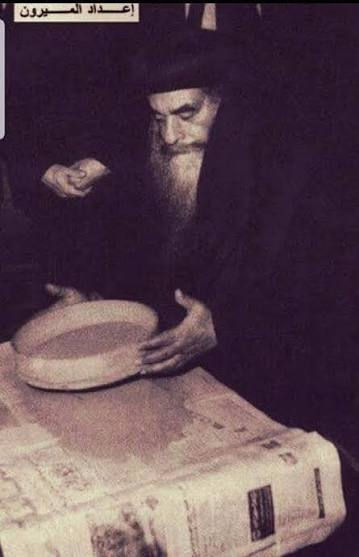
April 24, 1967 — At the beginning of the Holy Pascha week, His Holiness Pope Kyrillos commences the process of preparing the Holy Myron (Chrism) by gathering the ingredients for the monumental occasion, which had only taken place 25 times prior in the Coptic Church’s history. In preparation for the event, His Holiness had commissioned Dr. Youssef Mansour to prepare a book on the Holy Myron, which research considered over nine manuscripts. For five days, in the early mornings throughout the Holy Pascha week, the Holy Myron was slowly prepared and consecrated, with the personal involvement of His Holiness and many of the Metropolitans and Bishops of the Oriental Orthodox Churches. All the books of the Bible were read audibly throughout the entire process of preparation. On the eve of Thursday of the Holy Pascha week, the Holy Myron was placed beside the altar, and on Covenant Thursday, after the prayer of the Ninth Hour, His Holiness prayed over the Holy Myron. At the conclusion of the Covenant Thursday service, the Holy Myron was moved to the balcony of the great sanctuary, where it stayed until the Feast of the Resurrection (April 30, 1967). On the Feast of the Resurrection, after the Divine Liturgy, the combination of the existing and new Holy Myron commenced, continuing daily until the process was completed on Tuesday, May 2, 1967.


May 10, 1967 — Pope Kyrillos ordains Waheeb Atallah, who was his disciple since his days at the windmill, to the episcopacy as His Grace Bishop Gregorios of Higher Theological Studies, Coptic Culture, and Scientific Research, as well as His Grace Bishop Paulos for the diocese of Helwan and Massara. Later on the same day, Pope Kyrillos meets with Nasser in connection with various issues regarding the operations of al-Maglis al-Melli and related financial concerns. At this visit, Nasser congratulates His Holiness on the eighth anniversary of his ordination, at which time the pope curiously places his hand on Nasser’s chest, saying: “I place my hand on the hand of God, as it is written: ‘the king’s heart is in the hand of the Lord.’” That night, a government official notifies Pope Kyrillos that Nasser’s chest pain had resolved the moment the pope touched his chest. Although Nasser had a history of cardiac issues, including a suspected heart attack in 1965, these were hidden from public knowledge and even Nasser’s own wife. Nevertheless, in his characteristic clairvoyance, Pope Kyrillos was seemingly aware of the president’s angina, and acted in his typical manner by subtly, without pomp or any degree of showmanship, healing the president.


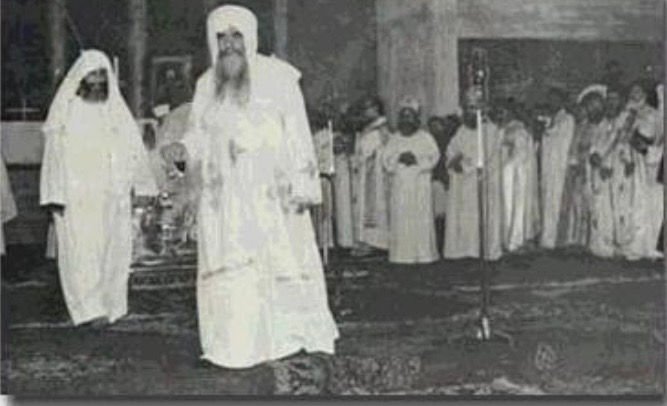
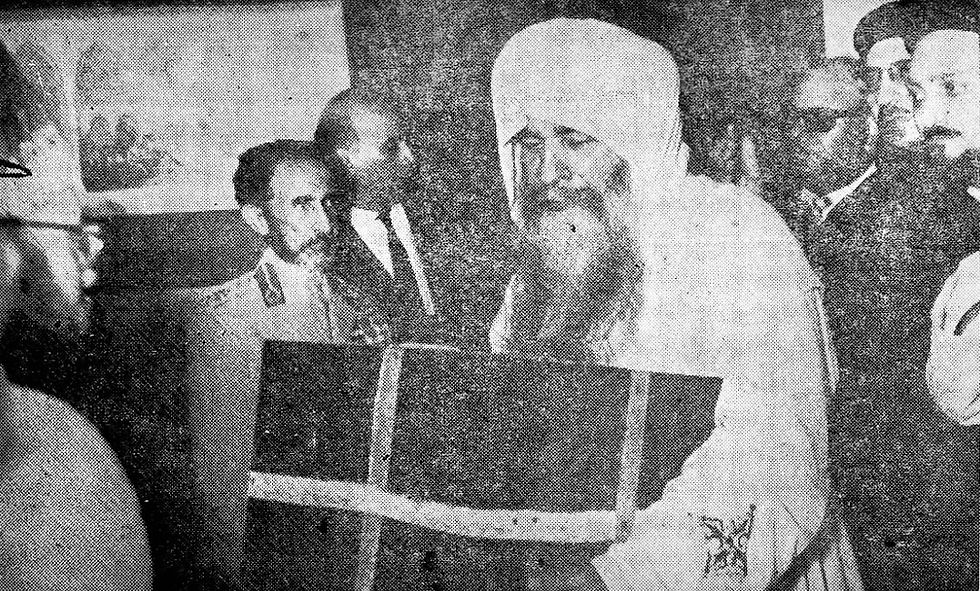
August 24, 1967 — Excavations on the new cathedral grounds begin. Only ten months later, on June 25, 1968, the new cathedral would be consecrated, during the year of the 1900th anniversary of the martyrdom of Saint Mark, in the presence of Pope Kyrillos, Nasser, Emperor Haile Selassie, several patriarchs, countless believers, government officials, and delegations from all over the world, and more than six thousand Egyptians and foreigners. The very next day, June 26, 1968, a relic of Saint Mark — which had been translated from Rome to Cairo the day before the cathedral’s inauguration and received at the airport by Pope Kyrillos himself along with Mar Ignatius Yacoub III and a great number of clergymen, several heads of religions and Christian denominations, and thousands of Egyptians, both Christian and Muslim — would be processed from al-Azbakeya to the new cathedral, where a Divine Liturgy would be prayed and a great celebration held, with the chest containing the relic being placed beneath the altar of the new cathedral.



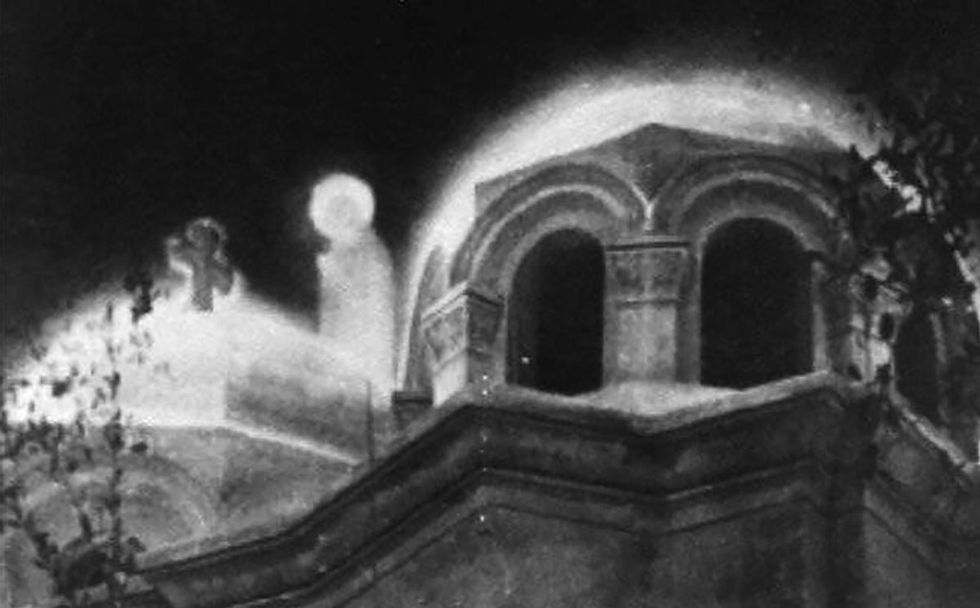
April 2, 1968 — The Marian Apparitions commence at the Church of the Virgin Mary in Zeitun, Egypt. One week later, on April 9, the Virgin appears there once again, and thereafter the apparitions become more frequent, occurring up to twice or more every week for several years, ending in 1971. Pope Kyrillos immediately forms a specialized committee headed by His Grace Bishop Gregorios to conduct a thorough and searching investigation, and on May 4, 1968, the Patriarchate issues an official statement confirming the validity of the apparitions. However, His Holiness does not personally attend the mass gatherings or otherwise make an effort to witness the apparitions firsthand. When asked about his absence, he noted the particular protocol applicable to his visit to any church, his desire not to influence the people regarding the apparitions, his intention to visit the church upon the completion of an icon for the church which he had commissioned depicting the Virgin’s apparition, and the fact that he had seen the Virgin Mary “since his youth,” including in her appearance and miracle in 1910 at his family’s home in Alexandria, an event which he stated “never left [his] mind.” He continued his response: “Now that millions have witnessed the apparition of the Virgin Mary above the Church of Zeitoun, and news of this apparition has spread from one end of the earth to the other . . . and witnesses have testified to this wondrous appearance, in this unique form in which she has never appeared before anywhere on earth . . . we bow down to God, praising Him for His support for us. . .”

[The published statement of the Coptic Orthodox Church authenticating the Zeitun Apparitions]
1968–1970 — When not at his beloved Monastery of Saint Mina, Pope Kyrillos continues in his daily routine of rising in the early morning to pray the morning praises, morning raising of incense, and Divine Liturgy — even in the still unfinished cathedral, without windows or heating — before meeting with the multitudes of his spiritual children who would come to him, to hear their problems, bless them, and pray for them. He would then proceed to the church once more for the evening praises, evening raising of incense, and midnight praises before once again meeting his visitors until late in the night, when he would return to his room and shut his door. Throughout this time, his final illnesses had begun, causing him to sometimes carry out this daily routine amidst high fevers and other severe symptoms.


May 1970 — Upon concluding a visit to the Monastery of Saint Mina, Pope Kyrillos bids the monks farewell with unusual tearfulness and great emotion. Overcome by tears, he confers with Hegumen Mina Ava Mina, the monastery abbot, before giving him monastic head coverings for each of the monks. He then proceeds to offer a special praise for Saint Mark and Saint Mina in both of the monastery churches, while holding an icon of Saint Mark which he had kept since his days of solitude in the desert. He then enters his car and attempts to smile at those standing by, but his tears continue to fall. This would be his final visit to his beloved monastery.
June 1970–March 1971 — Pope Kyrillos begins to delegate tasks and entrust various duties to his disciples and certain priests and bishops. He arranges envelopes for the widows and brethren of the Lord, among whom were many he had supported in secret for many years. Meanwhile, his illness continues to worsen, and he is confined to bedrest against his wishes on several occasions, preventing him from attending the liturgical prayers he so dearly loved and so forcing him to hear these broadcast live from the church through speakers he had requested that his disciple, Fr. Raphael Ava Mina, set up for him in his room. He remained so attentive to the prayers, even in this state, that after they would conclude, when the celebrants would come to receive his blessing, he would urge them not to rush the service, gently correct them if they erred in pronouncing a word, and encourage them not to neglect to pray certain parts of the Liturgy, such as the Litanies after the Gospel, that some had become accustomed to skipping. As he had throughout his papacy, he would also frequently sit at his window, or on his balcony, listening to those below as they mocked or complained of him, and he would say to himself: “they are justified in what they say.”
March 7, 1971 — Despite his ongoing illnesses, including a most recent bout of influenza, Pope Kyrillos insists to pray the Divine Liturgy, in direct contravention of his physicians’ orders. The following day, he invites his secretary into his room and solemnly advises him: “take care of the Church, Father; attend to its needs. . . May God be with you and attend to your affairs.”

March 9, 1971 — At 5:30 AM, Pope Kyrillos hears the prayers through the speaker in his room before receiving his visitors. He comforts each of them as he had done with his secretary: “May God attend to your affairs.” After a few hours, His Holiness comes to the door to ask whether any visitors remained. He then raises his cross, looks around at those around him, and repeats again, “May God attend to your affairs,” before shutting the door of his room, at which time he becomes light-headed and collapses. A disciple assists His Holiness to his bed and calls for a physician — by the time he arrives, at 10:30 AM, Pope Kyrillos has already reposed in the Lord. At this time, those closest to His Holiness enter the room to find him wearing his coarse inner garment. They vest him in ornate liturgical vestments rarely worn by him, having not yet read his will, which required that he be buried in his simple garments. Upon examining his private desk drawers, they find letters rife with insults and derision — the only letters His Holiness, in his typical fashion, had deemed worthy of preservation.
March 10, 1971 — The pure body of His Holiness is seated upon the patriarchal throne in the cathedral, on which he rarely sat during his papacy. Hundreds of thousands of mourners flock to the cathedral to receive the blessing of his body, and to bid farewell to their beloved father. Approximately seven thousand refuse to depart the cathedral, remaining there in a prayerful and tearful vigil until 5 AM the following day.

March 11, 1971 — The body of His Holiness is prepared for his funeral. The papal staff is placed in his left hand and a cross in his right hand. The locum tenens, Bishop Antonios of Suhag, eulogizes His Holiness, and at the conclusion of the service, His Holiness is laid to rest beneath the cathedral. His body would ultimately be transferred, on November 23, 1972, to the Monastery of Saint Mina, which he willed to be his final resting place — the monastery where his body remains until this day.


—
“Remember those who rule over you, who have spoken the word of God to you, whose faith follow, considering the outcome of their conduct.”
Hebrews 13:7
—
Sources:
Daniel Fanous, The Silent Patriarch: Kyrillos VI (1902–1971). Crestwood, NY: St Vladimir’s Seminary Press, 2019.
John Watson, Abba Kyrillos: Patriarch and Solitary, Coptic Church Review, Volume 17, Numbers 1 and 2 (Spring/Summer 1996).
Collected Egyptian Newspaper Articles relating to Pope Kyrillos VI (courtesy of Coptic Studies in Egypt):
Part 1: 1959–1965 (121 pages);
Part 2: 1966–2001 (150 pages).
Magdi Guirguis & Nelly van Doorn-Harder, The Emergence of the Modern Coptic Papacy. The Popes of Egypt: A History of the Coptic Church and Its Patriarchs, Volume 3. Cairo: American University in Cairo Press, 2011.
Edward Wakin, A Lonely Minority: The Modern Story of Egypt’s Copts. Revised edition, 2000.
Nelly van Doorn-Harder, “Kyrillos VI (1902–1971): Planner, Patriarch and Saint,” Nelly van Doorn-Harder and Kari Vogt (ed.), Between Desert and City: The Coptic Orthodox Church Today. Eugene, OR: Wipf & Stock.
Recorded interviews and lectures of the personal testimonies and eyewitness accounts of personal disciples and spiritual children of Saint Pope Kyrillos VI.


